|
R E P R O D U C T I V E A N A T O M Y
S e x u a l l y T r a n s m i t t e d I n f
e c t i o n s
When a woman is fertile, she's more susceptible
to Sexually Transmitted Infections (STIs), because slippery mucus and
an open cervix can both encourage semen to enter the uterus. Including
the possibility of STIs in your awareness is part of using Fertility
Awareness responsibly.
Most forms of contraception, including Fertility Awareness,
offer no protection from STIs. Before you have genital contact with
anyone, each of you should get tested for sexually transmitted infections.
County clinics often provide tests for free. The incubation of HIV can
take six months for it to show up in a test. Once you and your partner
have abstained from genital-genital contact or have been monogamous
for six months, then a test for HIV will be accurate. Test results for
HIV typically take two weeks, though a new test, costing about $150,
can give results in about 20 minutes. Other STIs can accurately be tested
immediately. If you have multiple partners, you should be tested every
six months.
If you have sex with someone who has not been tested
for sexually transmitted infections, only male or female latex or polyurethane
condoms can provide protection. Please be aware that men and women can
be allergic to latex. Skin reactions may be immediate, or slow in developing.
Try polyurethane condoms. Lambskin condoms can prevent pregnancy, not
STIs.
THE SIZE OF SEXUALLY TRANSMITTED INFECTIONS
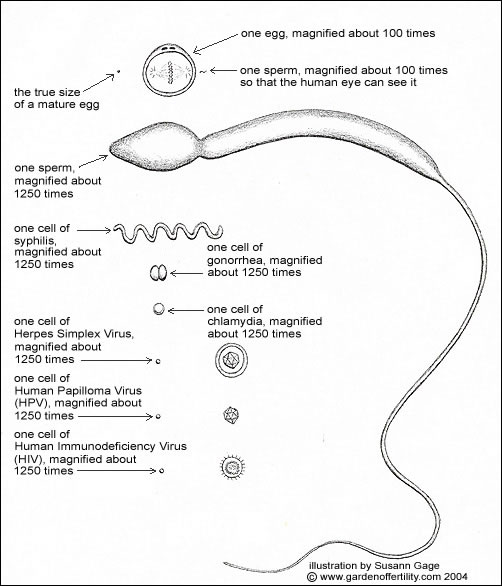
To get a sense of the size of an STI, consider that
the true size of a woman's mature egg is about the dot of a pen. If
you magnify that egg so that it's the size of a nickel, and put a dot
inside that nickel, then you can begin to see the size of one sperm
in relation to the size of one egg. The larger sperm shown here has
been magnified about 1250 times!
In this drawing, one cell each of the sexually transmitted
infections syphilis, gonnorhea, chlamydia, herpes, HPV and HIV has been
magnified as many times as the larger sperm shown here. This is why
lambskin condoms (which are slightly porous) can effectively prevent
pregnancy, but not STIs.
SYMPTOMS & TREATMENTS FOR SOME SEXUALLY TRANSMITTED
INFECTIONS
Syphilis
An ulcer or sore that appears on your vulva, vagina or cervix two to
four weeks after exposure may be a symptom of syphilis. Usually, the
ulcer doesn't hurt or itch. Syphilis is treated with antibiotics.
Gonnorhea
Usually, women who have gonorrhea do not have symptoms. Those who do
will have a yellow discharge, burning and soreness at the vulva, burning
while urinating, pain or bleeding during sex, a sore throat, or bleeding
between periods about ten days after exposure. Gonorrhea is treated
with antibiotics.
Chlamydia
Chlamydia is the most common sexually transmitted infection in the U.S.
Most women who have it do not show symptoms. Ten percent of women will
experience pain in their pelvis, pain during sex, burning while urinating,
yellow discharge, bleeding after sex, bleeding between periods, or fever.
Chlamydia is treated with antibiotics.
Herpes
About 20% of American adults have been infected with genital herpes.
Many women who carry the virus have no symptoms. Those who do have symptoms
may experience blisters or ulcers on their vulva or vagina. These lesions
can be very painful or itchy; they can last for a few days or a few
weeks. While there is no cure for herpes, meditation, homeopathy, acupuncture
and antiviral medications have been found to lessen the frequency of
lesions recurring.
Human Papilloma Virus (HPV)
HPV causes genital warts and is thought to be the primary cause of cervical
cancer. HPV is the most commonly transmitted virus in the U.S. Many
women who have HPV will not have symptoms. Women who do experience symptoms
may notice bumps on their vulva, at the vaginal opening, or on the anus.
These bumps may be flat or look like tiny cauliflowers; they might itch
or burn. HPV can cause abnormal pap smears. While there is no cure for
HPV, warts can be removed to decrease the chances of your transmitting
the virus to a partner.
Human Immunodeficiency Virus (HIV)
Most people who are in the early stages of HIV infection show no symptoms.
Those who do notice symptoms in the infection's early phase will experience
a skin rash, swollen lymph nodes, fever, severe fatigue. There is no
cure for HIV, and it can be fatal, though medications can often slow
down the infection.
HOW TO USE A CONDOM
Studies show that professional sex workers rarely
experience condom breakage, because they know how to use them. To increase
the effectiveness of condoms:
| * |
Before making love, have several condoms
available. |
| * |
Make sure their expiration date has not expired. |
| * |
If you have sex when you're in your fertile phase
or if you're unsure if your fertile, you can use vaginal spermicide--either
spermicidal jelly with a diaphragm or a cervical cap, Delfen foam,
or vaginal suppositories (Encare) in addition to the condom. The
amount of spermicide used on condoms which claim to be lubricated
with spermicide is miniscule: it does not provide sufficient protection
in preventing pregnancy if the condom breaks or slips off. So even
if a man's condom is labeled "lubricated with spermicide nonoxyl
9," for contraceptive protection, the woman should still use
vaginal spermicide. |
| * |
If the woman is not well lubricated, intercourse
can be painful for her, and friction created by intercourse in dryer
vaginal walls can also weaken the condom. Enjoy plenty of foreplay
so that the woman is well lubricated before intercourse. |
| * |
If foreplay doesn't make the woman sufficiently
lubricated, apply a water-based lubricant on the outside of the
condom after it's on the penis. Hand lotion and baby oil can encourage
breakage, because they're oil-based. For added pleasure and to prevent
friction, you can continue to add water-based lubricant as needed
throughout lovemaking. |
| * |
While applying the condom, keep the tip pinched
to prevent an air bubble. Roll it down to the base of the penis. |
| * |
If you have sex for more than 30 minutes, or
if your partner ejaculates and you continue having genital contact,
remove the old condom and apply a new one. |
| * |
Remove the condom after ejaculation. Hold the
condom's rim against the base of the penis while withdrawing from
the vagina. When removing the condom from the penis, keep the penis
turned away from the vagina. |
| * |
Wash hands and the penis before cuddling. |
| * |
If a man has difficulty maintaining an erection
while using a condom, he can learn to use one by masturbating with
one on. |
| * |
If the condom breaks while you are making love,
the woman has 72 hours to take the Emergency Contraceptive Pill
(ECP). Call 1.888.NOT-2-LATE (888.668.2528) to learn about health
care providers in your area who prescribe this pill. You can also
check www.not-2-late.com. The sooner the ECP is used after unprotected
or inadequately protected intercourse (i.e. pills are missed, condoms
break), the more effective it is. The ECP is not designed to be
used as a regular method of contraception. |
| * |
A broken condom sometimes signals miscommunication
within a relationship. As you address the possibility of an unintended
pregnancy, or the possibility of contracting an STI, you may also
need to communicate your needs more clearly--to yourself and to
your partner. |
RESOURCES
American Social Health Association (ASHA), PO Box
13827, Research Triangle Park, NC 27709; 919.361.8400;http: www.ashastd.org/.
This organization operates hot lines and publishes numerous materials.
Several of their publications, including Questions and Answers about
Chlamydia, PID, Herpes (etc.) are available for free. Their National
Herpes Hotline operates Monday through Friday, 9am to 7pm, EST, at no
charge. 919.361.8488.
Bell, Ruth, et al, Changing Bodies, Changing Lives:
A Book for Teens on Sex and Relationships, revised edition, Vintage,
1998. Our Bodies, Ourselves for teenagers.
The Boston Women's Health Book Collective, Our
Bodies, Ourselves for the New Century, Simon and Schuster, 1998.
This book is a bible for women wanting clear information and personal
experiences for a wide range of topics. In the section on STIs, descriptions
of women's and men's symptoms numerous infections are given, along with
straightforward information about how tests and diagnoses are made,
and what treatments (including alternatives) are available. A Spanish
edition, Nuestros Cuerpos, Nuestros Vidas was issued in 2000
by Seven Stories Press. www.ourbodiesourselves.org
Federation of Feminist Women's Health Centers, A
New View of a Woman's Body, Feminist Health Press, 1995. Includes
clear information and drawings about common infections. Order from Feminist
Health Press, 8240 Santa Monica Blvd., Los Angeles, CA 90046. www.womenshealthspecialists.org.
www.plannedparenthood.org
Your local office is listed in the white and yellow pages of your phone
book.
Project Inform, 205 13th Street, Suite 2001, San
Francisco, CA 94103-2461; hotline 800-822-7422; admin 415-558-8669.
http://www.projinf.org
A nationwide referral organization for HIV/AIDS treatment.
|